

Summary
A good-looking website can still underperform in search if structure, speed, and usability are weak. This article explains how design choices affect rankings, trust, and lead volume.
Your website can look professional and still do very little for search if it was built with design on one side and SEO on the other. We see that often with local businesses shopping for a rebuild or trying to figure out why a recent launch did not help much. The site goes live, it feels like progress, and then rankings barely move, forms stay quiet, and it is hard to tell whether the issue is traffic, messaging, or the site itself.
Search engines and human visitors often respond well to some of the same fundamentals, though not always for the exact same reasons. Clear page structure helps crawlers understand your content and helps people find what they need fast. Faster pages can support better visibility and also reduce drop-off. Obvious paths to call, book, or request a quote improve usability first, and they usually help the business side of SEO too. That is why seo web design services matter more than many owners expect. Design affects crawlability, trust, and whether a visit turns into a lead.
Why SEO starts with the website itself
SEO problems often begin in the build.
Not with blog posts. Not with ads. In the way the site is organized, labeled, and presented on mobile.
A redesign can look polished and still be hard to rank. You will see local business sites with strong visuals, big hero images, and clean branding, but the important pages sit three clicks deep, the navigation says almost nothing, and the layout never makes it clear what the company offers or where it works. Search engines depend on structure, internal links, headings, and page focus. Visitors follow those signals too, just with less patience.
- Service pages are tucked under generic menu labels like “solutions” or “what we offer”
- Location pages exist, but they are thin or hard to reach from the main navigation
- Key content sits in tabs, sliders, or design blocks that get less attention
- Mobile layouts push the phone number, form, or call button too far down
- One page tries to cover every service and every town, so it ends up weak for all of them
If you are hiring a web design company, this is the part that deserves more scrutiny than most owners give it. A site can launch on time and still leave you with buried service pages, weak local relevance, and a mobile experience that makes leads harder to capture. Then the next vendor has to “do SEO” on top of a structure that was working against you from day one.
That is the real value of getting the foundation right. Design alone will not rank your site, but it does shape whether the rest of your SEO work has a fair chance to perform.

Site structure shapes what can rank
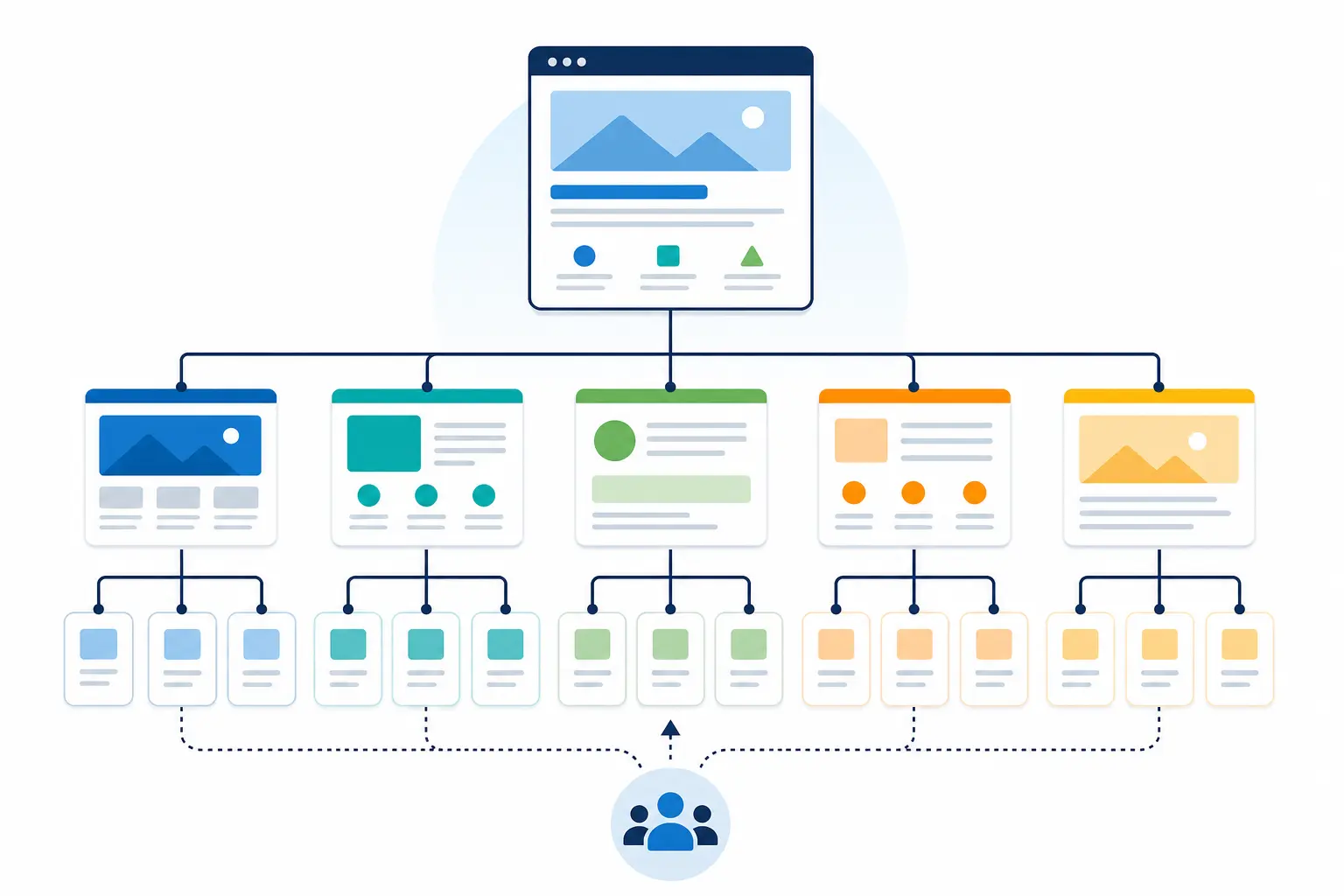
Structure is the way your pages are organized, named, linked, and prioritized. Simple idea, big impact. It tells Google whether your site has clear service topics or whether it is one blurry local business website trying to rank for everything at once.
For most local service businesses, the cleanest setup is straightforward. One homepage for the brand and primary market. Separate pages for each core service. Location pages only where you have something specific to say. Trust pages for reviews, about, financing, warranties, or project examples. Then clear contact paths from all of them. You want navigation that feels easy to use, but you also need enough depth to support the services and areas you actually want to show up for.
A lot of websites miss this by stuffing every service and every city onto the homepage. It feels efficient. It usually weakens relevance. A page trying to rank for four service lines and six towns is rarely the best answer for any one search. On the other side, spinning up twenty near-copy location pages with only the town name changed creates its own problem if those pages add nothing useful.
Check your site like this:
- Can a visitor reach each main service page in one or two clicks?
- Do navigation labels say what you actually do, or do they hide it behind vague wording?
- Does each location page include distinct local content, proof, photos, or work examples?
- Are your priority pages linked from related pages, not just buried in a menu?
- Can someone move from a service page to contact, estimate, or scheduling without hunting for it?
Internal linking does more work than many owners realize. Link related service pages, location pages, and trust pages into the pages you most want to rank and convert. That helps search engines understand your priorities, and it helps people keep moving instead of backing out. If a company is offering seo web design services, it should be able to explain this plainly before the build starts, not after launch when fixes get more expensive.
Speed affects trust before it affects rankings
Once the structure is right, speed gets practical fast. People do not experience your site as a technical score. They experience it as hesitation. A page hangs, the phone number does not show up, the form jumps around, and they leave.
For local service businesses, that usually happens on mobile first. Your prospective customer may be comparing providers between appointments, sitting in a truck, or trying to send a quick quote request before getting back to work. If your site takes too long to load because of oversized images, a bloated theme, autoplay video, too many popups, or plugins fighting each other, you can lose the lead before rankings have much chance to help.
We see owners chase page speed scores in the 90s while ignoring the obvious friction people actually feel. Start there:
- Compress oversized homepage images
- Remove scripts you do not use
- Cut back autoplay video unless it clearly earns its spot
- Be careful with chat tools, review widgets, trackers, and heavy animations
Some of those features do help conversion. Sometimes a chat tool is worth the extra weight. Sometimes strong visuals matter. But you should make those trade-offs on purpose, not because the template came packed with features you never asked for.
Good seo web design services do not treat speed like a lab exercise. They look at whether your key pages load cleanly, whether tap-to-call shows up right away, whether forms work without lag, and whether the site still feels solid after you add the marketing tools you actually need.

UX turns rankings into leads
Getting found is only half the job. Once someone lands on a service page from Google, they need quick confirmation that you do the work they need, in the area they need it, and that contacting you will be easy.
The basics should be obvious right away: a plain-English service headline, the city or service area, a phone number that is easy to tap, and a call to action that says what happens next. “Request a quote” is fine. “Let’s talk” is vague. Same with forms. If your form asks for ten fields on mobile, people leave. For most local businesses, name, contact info, service need, and a short message are enough to start.
Small UX misses cost leads. Hidden phone numbers in a sticky menu. Tiny text over a photo. A contact button that drops people onto a generic page. Navigation labels that make sense to your team but not to a customer in a hurry.
Trust matters close to the point of contact, not buried at the bottom. Put reassurance near the form or click-to-call button:
- Clear service-area wording
- Recent reviews
- License or certification details where relevant
- Before-and-after work, if your service is visual
Accessibility overlaps with UX in a practical way. Readable font sizes, decent contrast, labeled form fields, buttons large enough for thumbs. That does not guarantee higher rankings on its own. It does make your search traffic easier to use, which is what turns visits into calls, bookings, and quote requests.
How to choose the right web design partner
You are not just buying a nicer layout. You are trying to avoid a site that launches looking polished and then needs SEO repairs a month later.
Ask how the site is planned before design starts. If a company talks almost entirely about colors, layouts, and brand feel, but gets vague on page hierarchy, internal linking, mobile behavior, or what happens after launch, be careful. The same goes for anyone treating SEO like a later add-on. For most local businesses, that turns into weak service pages, messy rebuilds, and extra cost you did not budget for.
The reassuring signs are usually the practical ones. A sitemap. Planned service and location page structure. Wireframes that show content priority, not just visuals. Performance testing before launch. Clear notes on who owns the site, the content, the hosting setup, and who handles updates once the project is live.
- How do you plan the sitemap and content hierarchy around my core services?
- What do you check for page speed and mobile usability before launch?
- How will navigation, internal links, and calls to action be handled on service pages?
- Who owns the website files, content, and logins when the project is done?
- Do you offer ongoing optimization, maintenance, and technical support after launch?
Seller's Bay has over 27 years of online marketing experience with clients worldwide. If you want a site that is built with search visibility, usability, and lead generation in mind from the start contact us today.
Frequently asked questions
What is SEO in web design?
It means building the site so search engines can understand it and people can use it without friction. On a local business site, that usually comes down to clear service pages, sensible navigation, internal links, fast mobile loading, and obvious paths to call or request a quote. A pretty layout doesn't help much when your main pages are buried, vague, or slow.
How much does an SEO service cost?
It depends on what you're buying. A one-time SEO review for a website rebuild is different from ongoing SEO work after launch. For this article, the bigger issue is scope. If a company says it does SEO web design services, ask whether site structure, page hierarchy, mobile usability, internal linking, and speed fixes are included, or if they're selling design first and calling the rest an add-on.
How much should I expect to pay for SEO?
Expect the price to follow the amount of work and how broken the foundation is. A local business with thin service pages, weak location pages, and a slow mobile site usually needs more than a few title tag edits. Cheap SEO often lands on top of a bad build and stalls there. Get clarity on what will actually be fixed before you compare quotes.
Is it worth paying for SEO services?
Usually, yes, if your site has real issues with structure, speed, and conversion paths. We've all seen websites that look finished but make it hard for Google to understand the services and hard for visitors to contact the business. Paying for SEO makes more sense when it improves the website itself, not just publishes a few blog posts while buried pages and weak mobile layouts stay untouched.
Do rankings improve just because a website gets redesigned?
No. A redesign can help, but only when it fixes the parts that were holding search back. Better page structure, clearer service and location pages, stronger internal linking, and faster mobile performance can improve how the site performs. A visual refresh by itself won't do much if the new build still hides key pages, loads slowly, or makes lead actions hard to find.
Our approach to web design services brings page structure, content and the customer journey together. For ongoing search support after launch, see our SEO services.
For a practical next step, read Why SEO Should Be Built Into Web Design From Day One and Tips For Improving Your Website User Experience.

0 Comments